Sunday, April 29, 2012

Good Idea: Swept Wing [Redux]

Early planes had “straight” wings: they jut out perpendicular to the fuselage. They’re easy to build and generate lots of lift. And yet no jet plane uses them. Why not?


The Sound Barrier (or as nerds pronounce it, “compressibility”). Physics predicts that going faster takes more power (black line). But close to the speed of sound, the air molecules have no time to get out of the way. Going a little faster takes way more power than predicted.

The answer is to trick the wind by “sweeping” the wing and tilting it backwards. Before, the wing hit the air at the same speed as the plane. Tilted, it is off-angle to the air and has an effective speed of the plane speed times the cosine of the tilt. This lower speed allows the plane to fly faster than the speed of sound without hitting the sound barrier.

450 mph. Planes slower than that have straight wings. Faster and it will have swept wings. The faster the plane, the steeper the sweep.


[This is a revised version of an earlier post. Fewer words, more illustrations, with bad drawing. Comments requested.]

Friday, April 27, 2012

Awesome Shuttle Planes

Normal 747 w/Instagram filter "Shuttle"
The Space Shuttle was a boondoggle: it was doomed to failure by economics and engineering before it began. But like most boondoggles, it came with some really awesome toys. And two of them happen to be airplanes.

Airplane humor

Shuttle Carrier Aircraft

The Space Shuttle itself cannot fly. It can rocket straight up, but so can wingless 1970’s era space capsules. And it can glide. But the Wright Brothers’ first aircraft can fly more than the Space Shuttle. So, when the Shuttle lands in California, the only way to get it back to Florida is to hitchhike. On top of a 747. NASA bought 2 jumbo jets and added supports and stabilizers to create the capable-but-unimaginatively-named Shuttle Carrier Aircraft.


I'm a Space Shuttle! I'm a Space Shuttle!

Shuttle Training Aircraft

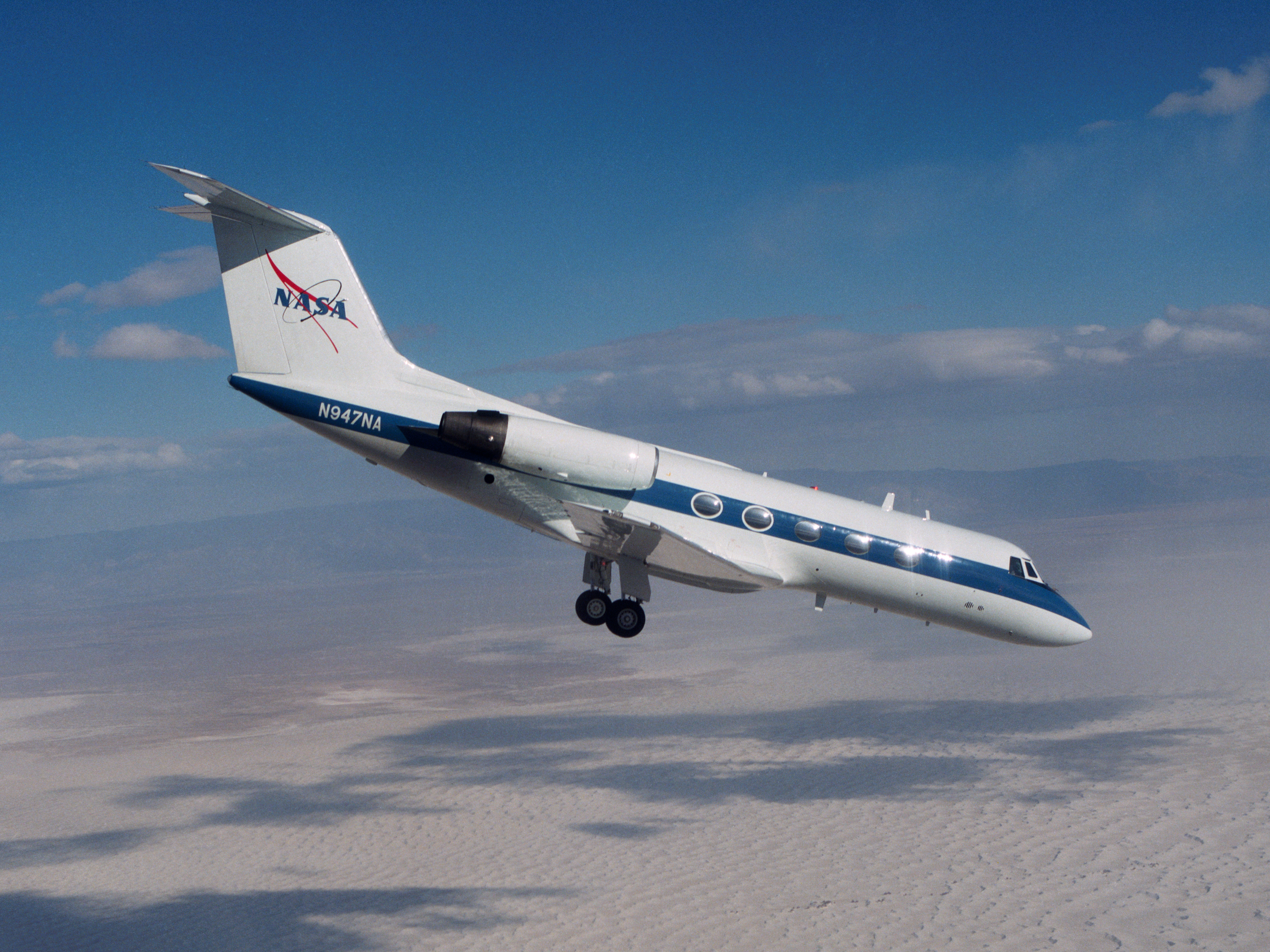
Oh, about the Space Shuttle not flying? When landing, the Space Shuttle is the world’s largest glider. Winds too strong? A normal airplane would circle another five minutes. The Space Shuttle is going to succumb to gravity. If you’re piloting, you’d really prefer to put those 100 tons of metal down on a runway. That takes training. More realistic training than a simulator can give you. The answer: the (again, very unimaginatively named) Shuttle Training Aircraft.

NASA took a Gulfstream II (the great great grandfather of the G6 of “Like a G6” fame) and made it pretend to be a Space Shuttle. This is like making a Miata that handles like an 18-wheeler. Or a canine Freaky Friday where a Chihuahua acts like a St. Bernard. This confused identity requires three tricks:

"If your side's so great, Buzz, where's the cupholder?"

  • avionics (brains) that react slower to commands.
  • a less aerodynamic plane. Simulating the Shuttle includes lowering flaps and landing gear even at 37,000 feet to slow the plane down. But even with everything deployed, a Gulfstream is still too much plane and not enough brick so the STA has to reverse thrust to be sufficiently slow. Standing on the brakes isn’t enough to make a Miata into a truck; it has to floor the gas in reverse, too.
  • a Mullet of a cockpit: business (jet) on the right; party/Space Shuttle on the left.

The Space Shuttle doesn’t fly anymore and so neither will these affronts to aerodynamics. But we’ll always be able to remember, and laugh at, them.

Sunday, April 22, 2012

Nifty Travel Tool: SeatGuru

You’re booking a trip and you get to seat selection. Which seat is best? Or, let’s be honest, is least bad? Is it worth paying $15 for the “Preferred Plus” seat?

http://seatguru.com has the answer. It turns out, there are a lot of things that can make a seat good or bad, and SeatGuru considers them all:

  • legroom (more is better)
  • in-seat power (and whether it’s normal AC or cigarette lighter DC)
  • closer to front of plane (first to deplane)
  • exit row (more legroom, but tray tables in armrests make them narrower and some don’t recline)
  • proximity to galley and/or lavatory (flight attendants and passengers gather noisily)
  • in-flight entertainment hardware that takes up space under the seat in front of you
  • air-conditioning vents that can’t be adjusted over one seat on the airplane (why?)
  • seat likely to be bumped by food cart
  • extra storage space for window seats

You’ve certainly considered some of these. But do your future self a favor: don’t get stuck in a surprisingly bad seat.

Sunday, April 8, 2012

Unfortunately, Airlines

Airplanes are Awesome. But Airlines are the only way to experience airplanes, and they are decidedly Less Awesome. Here’s my advice on how to survive in today’s age of baggage fees and delays.

There are two ways to pick a flight:

  • Best (actually, Cheapest) Flight
  • Best Airline

The first way is the easiest: you have a flight coming up, you put it into Kayak/Expedia/Travelocity (or Hipmunk, a new and better site) and pick the best (and by best you mean cheapest). Congratulations. You have saved $18. And had to learn a new airport terminal, paid a $25 bag fee, almost missed your flight, and got no frequent flier miles. In case I’m being too subtle, I don’t think this is a great option.

If you travel at all regularly (4 or more times a year), I recommend you pick an airline. You won’t fly this airline if it’s $500 more, but you will if it’s $5 more; if it’s $50 more you might go either way. And what do you get for this $5-50?

Frequent Flier Miles. For 25,000 miles, you can get a ticket that would cost $500. That’s 2 cents per mile, which means a New York-LA round trip (round-trip distance 4,950 miles) gets you $99 of frequent flier miles. But you can only redeem the miles if you earn enough. It’s worth paying $25 to get a free $74.

Frequent Flier Status. The more you fly an airline, the better they treat you. They don’t charge you bag fees, they let you through security faster, they throw extra miles at you. Sometimes, they’ll even put you in first class for free (or discounted). And, best of all, when the weather goes wonky or the plane needs maintenance, you’re first in line to get home. The threshold for this kind of treatment is lower than you might think. (And new credit cards offer many of these perks even if you only travel once a year.)

Familiarity. Maybe I’m making too big a deal of this, but I like the familiarity. You know how boarding works, you know which airport restaurant is the least greasy. On a trip that’s going to wear you out, I like knowing what to expect.

Next I’ll help you figure out with Airline is Best for You.