Sunday, April 29, 2012

Good Idea: Swept Wing [Redux]

Early planes had “straight” wings: they jut out perpendicular to the fuselage. They’re easy to build and generate lots of lift. And yet no jet plane uses them. Why not?


The Sound Barrier (or as nerds pronounce it, “compressibility”). Physics predicts that going faster takes more power (black line). But close to the speed of sound, the air molecules have no time to get out of the way. Going a little faster takes way more power than predicted.

The answer is to trick the wind by “sweeping” the wing and tilting it backwards. Before, the wing hit the air at the same speed as the plane. Tilted, it is off-angle to the air and has an effective speed of the plane speed times the cosine of the tilt. This lower speed allows the plane to fly faster than the speed of sound without hitting the sound barrier.

450 mph. Planes slower than that have straight wings. Faster and it will have swept wings. The faster the plane, the steeper the sweep.


[This is a revised version of an earlier post. Fewer words, more illustrations, with bad drawing. Comments requested.]

Friday, April 27, 2012

Awesome Shuttle Planes

Normal 747 w/Instagram filter "Shuttle"
The Space Shuttle was a boondoggle: it was doomed to failure by economics and engineering before it began. But like most boondoggles, it came with some really awesome toys. And two of them happen to be airplanes.

Airplane humor

Shuttle Carrier Aircraft

The Space Shuttle itself cannot fly. It can rocket straight up, but so can wingless 1970’s era space capsules. And it can glide. But the Wright Brothers’ first aircraft can fly more than the Space Shuttle. So, when the Shuttle lands in California, the only way to get it back to Florida is to hitchhike. On top of a 747. NASA bought 2 jumbo jets and added supports and stabilizers to create the capable-but-unimaginatively-named Shuttle Carrier Aircraft.


I'm a Space Shuttle! I'm a Space Shuttle!

Shuttle Training Aircraft

Oh, about the Space Shuttle not flying? When landing, the Space Shuttle is the world’s largest glider. Winds too strong? A normal airplane would circle another five minutes. The Space Shuttle is going to succumb to gravity. If you’re piloting, you’d really prefer to put those 100 tons of metal down on a runway. That takes training. More realistic training than a simulator can give you. The answer: the (again, very unimaginatively named) Shuttle Training Aircraft.

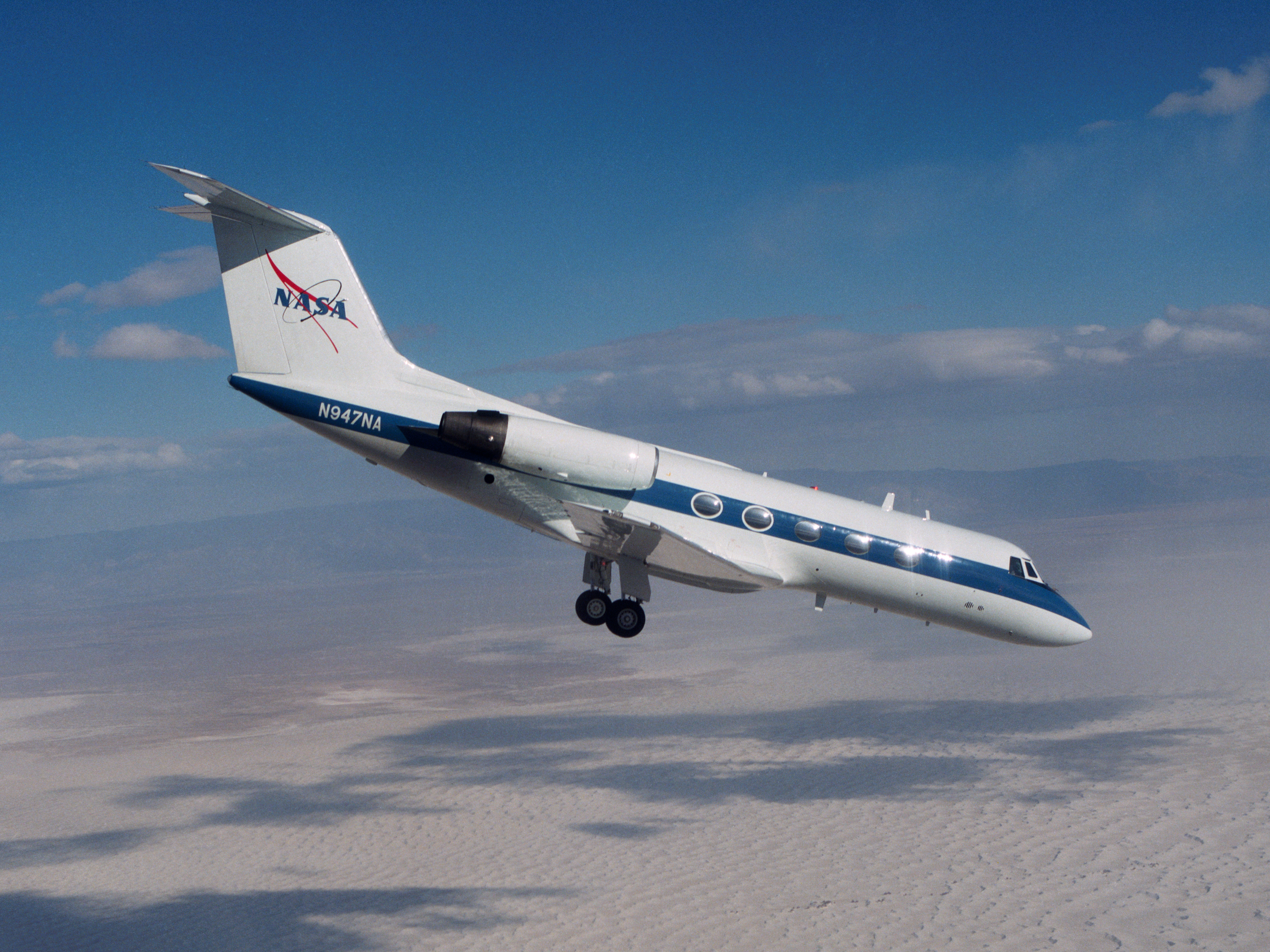
NASA took a Gulfstream II (the great great grandfather of the G6 of “Like a G6” fame) and made it pretend to be a Space Shuttle. This is like making a Miata that handles like an 18-wheeler. Or a canine Freaky Friday where a Chihuahua acts like a St. Bernard. This confused identity requires three tricks:

"If your side's so great, Buzz, where's the cupholder?"

  • avionics (brains) that react slower to commands.
  • a less aerodynamic plane. Simulating the Shuttle includes lowering flaps and landing gear even at 37,000 feet to slow the plane down. But even with everything deployed, a Gulfstream is still too much plane and not enough brick so the STA has to reverse thrust to be sufficiently slow. Standing on the brakes isn’t enough to make a Miata into a truck; it has to floor the gas in reverse, too.
  • a Mullet of a cockpit: business (jet) on the right; party/Space Shuttle on the left.

The Space Shuttle doesn’t fly anymore and so neither will these affronts to aerodynamics. But we’ll always be able to remember, and laugh at, them.

Sunday, April 22, 2012

Nifty Travel Tool: SeatGuru

You’re booking a trip and you get to seat selection. Which seat is best? Or, let’s be honest, is least bad? Is it worth paying $15 for the “Preferred Plus” seat?

http://seatguru.com has the answer. It turns out, there are a lot of things that can make a seat good or bad, and SeatGuru considers them all:

  • legroom (more is better)
  • in-seat power (and whether it’s normal AC or cigarette lighter DC)
  • closer to front of plane (first to deplane)
  • exit row (more legroom, but tray tables in armrests make them narrower and some don’t recline)
  • proximity to galley and/or lavatory (flight attendants and passengers gather noisily)
  • in-flight entertainment hardware that takes up space under the seat in front of you
  • air-conditioning vents that can’t be adjusted over one seat on the airplane (why?)
  • seat likely to be bumped by food cart
  • extra storage space for window seats

You’ve certainly considered some of these. But do your future self a favor: don’t get stuck in a surprisingly bad seat.

Sunday, April 8, 2012

Unfortunately, Airlines

Airplanes are Awesome. But Airlines are the only way to experience airplanes, and they are decidedly Less Awesome. Here’s my advice on how to survive in today’s age of baggage fees and delays.

There are two ways to pick a flight:

  • Best (actually, Cheapest) Flight
  • Best Airline

The first way is the easiest: you have a flight coming up, you put it into Kayak/Expedia/Travelocity (or Hipmunk, a new and better site) and pick the best (and by best you mean cheapest). Congratulations. You have saved $18. And had to learn a new airport terminal, paid a $25 bag fee, almost missed your flight, and got no frequent flier miles. In case I’m being too subtle, I don’t think this is a great option.

If you travel at all regularly (4 or more times a year), I recommend you pick an airline. You won’t fly this airline if it’s $500 more, but you will if it’s $5 more; if it’s $50 more you might go either way. And what do you get for this $5-50?

Frequent Flier Miles. For 25,000 miles, you can get a ticket that would cost $500. That’s 2 cents per mile, which means a New York-LA round trip (round-trip distance 4,950 miles) gets you $99 of frequent flier miles. But you can only redeem the miles if you earn enough. It’s worth paying $25 to get a free $74.

Frequent Flier Status. The more you fly an airline, the better they treat you. They don’t charge you bag fees, they let you through security faster, they throw extra miles at you. Sometimes, they’ll even put you in first class for free (or discounted). And, best of all, when the weather goes wonky or the plane needs maintenance, you’re first in line to get home. The threshold for this kind of treatment is lower than you might think. (And new credit cards offer many of these perks even if you only travel once a year.)

Familiarity. Maybe I’m making too big a deal of this, but I like the familiarity. You know how boarding works, you know which airport restaurant is the least greasy. On a trip that’s going to wear you out, I like knowing what to expect.

Next I’ll help you figure out with Airline is Best for You.

Saturday, March 31, 2012

Every 50 Seats

You will never see a plane with 51 seats. Why? The FAA requires one flight attendant per 50 seats. That 51st seat can generate 2% more revenue (on a sold out flight) but requires 100% more flight attendant cost (on every flight). 52 seats offers 4% more revenue, 53 6% more. How many seats does it take to make enough money to justify a second flight attendant?
You’re looking at a histogram of number of planes with a number of seats. The horizontal axis is number of seats on a plane; the vertical axis the number of commercial planes in the US with that number of seats. I collected this data from Wikipedia (e.g., American Airlines Fleet) into a Google Spreadsheet. For instance: the “40” column goes up to 116. There are 116 planes with 31-40 seats. What does this graph (detailed, interactive version) tell us?

There are ten times as many planes with 41-50 seats (1112) as there are with 31-40 seats (116). Once you’re paying a flight attendant, you want to get your money’s worth.

There are no planes with 51-60 seats. In fact, the next plane has 64 seats. Without talking to accountants, we know it takes 14 seats of revenue to offset the cost of one flight attendant.

The same cliff happens at 100 seats and 150 seats. The effect weakens at 200 seats and beyond because of first and business class. Premium service requires more flight attendants, so the FAA requirements are less demanding than first class customers.

Popular planes make their own peaks. The 140 bump is due to Southwest’s 587 (!) identical 737-300s. The bump at 180 and 190 is the venerable 757 (it’s split over two values because different airlines put in different size first class cabins).

Sunday, March 18, 2012

Ahead of its Time: the de Havilland Comet

The de Havilland Comet was the Neanderthal Icarus of jetliners. “Neanderthal” in that it came first, but rooted no family trees. “Icarus” because it flew too high and failed.

The Comet was the first jetliner. It first flew in 1949 and carried paying passengers in 1952. It looks modern enough (all-metal body, swept wings, pressurized cabin) but for the engines and the windows. It has 4 (instead of 2), small (instead of large) jets mounted inside the wings (instead of podded) and rectangular (instead of rounded) windows.

Those windows were the Achilles Heel of the wax of its Icaru-- Wait. Too many metaphors. More simply: you’ve never head of the Comet because it windows were critically flawed. Pressurization pushed each window out with a ton of pressure (16.6 inches wide * 14 inches high * 8.25 psi). The window’s glass held, but passed the weight to the metal frame unevenly: the square shape pushed much more at the corners. Like bending a paper clip back and forth, it fatigued the frame until even a small force could break the metal.

Two Comets blew apart in mid-air in 1954. Authorities blamed sabotage, until forensic evidence proved the planes failed in the same way. Very smart people figured out what I described above and De Havilland spent 4 years reengineering the Comet. On October 4th, 1958, a Comet operated the first London-New York passenger jet flight. The Comet’s monopoly didn’t last long: later that month, Pan Am flew the same route with the larger, faster, more efficient, better looking, more popular 707. The Comet’s biggest contribution to aviation is a stark reminder that, at 30,000 feet, little details matter.

Sunday, February 26, 2012

Life of a Jetliner

A well-maintained Jetliner can last 30 or 40 years. What happens over the course of those decades?

Shiny and New (0-5 years)
Fresh off the assembly line, this plane has the latest technology. Today, this includes at-seat electrical power, in-flight WiFi, LED lighting, swivel bins, fancy seats. All the gadgets still work. The little touches combine to make an atmosphere: when you walk through the entrance, you look up and smile. This flight will be a little less dreary. Virgin America’s planes still have this shine on them.

Settling In (5-10 years)
Everything works. It... works. Your seat works. The in-flight-entertainment works, but it’s showing its age. The screen’s too small, the graphics too blocky. You’re happy to fly this plane, because it could be worse. Think JetBlue.

Journeyman (10-20 years)
No one claims this is still a new plane. But it’s cheaper to keep flying than to replace. The plane isn’t too old to learn new tricks: new seats inside so the airline can sell more tickets, winglets on the outside to improve efficiency, perhaps a new paint job to match the latest fashion. These overhauls fit well during a “D” maintenance check: every 5 years check the plane by taking it all the way apart and putting it back together.

Second career (20 years)
It may happen after 10 years, or after 30. But there comes a point that the first owner of a plane is done with it. In our next post, we’ll see what becomes of second-hand planes.

Sunday, February 19, 2012

B-36

The early Cold War was a time of improved technology but even more inflated expectations. Nuclear weapons were politically important, but unwieldy. (The B-29s that dropped nuclear weapons on Japan had to be specially modified; they were so close to the ground that to load they had to straddle pits dug in the runway.) The B-29 could deliver a finishing blow from near-by islands, but the Air Force wanted a plane that could span the globe to strike at the heart of the enemy flying from the USA (originally the enemy was Germany, but after WWII they just search-and-replaced to USSR). The result was the B-36.

The B-36 is an enlarged WWII bomber. The wings are straight not swept. Defensive turrets sprinkle the skin, even though increasing speeds rendered them practially useless. The engines are all in the wings, not podded. Oh, and there are ten (ten!) of them. Oh, and four of them are jets and six are piston engines. That’s right, it’s a pre-Prius hybrid. To optimists, this was the perfect mix of jets’ added thrust (for take-off and high-speed dashes) and pistons’ reliability and efficiency. This was a plane with an infomercial sales pitch, but it came along at America’s insomniac 2AM and taxpayers bought it.

With that context, the portraits themselves. A B-36 next to a B-29 looking the same, but larger, but less elegant. An early configuration with one giant tire. Another configuration with tank tracks instead of wheels. (Eventually, they settled on the normal many-wheeled model that every sane design ever uses.)

The B-36 proudly served for 7 years before its replacements arrived and the Air Force started scrapping them.

Middle School Portraits

Kids are cute; adults are functional. In the middle is puberty. If middle school was awkward for you. (And if middle school was really your life’s peak, well, I’ll try to use smaller words.) Planes are the same way. Early attempts at integrating jet engines are gangly-looking, braces-wearing, compromises. These planes have no descendants, and are worth looking at not to learn but to laugh.

Sunday, February 12, 2012

Plane Card: B-47 Stratojet

The B-47 Stratojet is the first modern plane. Any plane made before it (and many after!) would catch your eye as dated if you saw it an airport. The B-47 would look small and a bit awkward, but has stood the test of time. It combined for the first time a pressurized cabin, swept wings, and podded engines.

It was the gleaming new toy/weapon for the Strategic Air Command (the branch of the Air Force responsible for socking it to the Soviets). First flown in 1947 and deployed in 1951. It starred in a propaganda film (sort of a proto-Top Gun) put out by Paramount Studios: Strategic Air Command, sharing the spotlight with Jimmy Stewart. (Fun Fact: Jimmy Stewart was a pilot who flew more than 20 bomber combat missions over Europe.)

But the B-47 carried bombs, not passengers. It set technical achievements but didn’t change the way we travel. So why care about it? Building the B-47 gave Boeing the requisite expertise (and cash) to take these technical advances into the realm we care about. The B-47 isn’t the grandfather of the planes we fly in today; it was the rich uncle that paid grandpa’s tuition.

Sunday, January 29, 2012

Swept Wings

Straight wings are easy. Wings that jut out from the fuselage at 90 degrees are simple to build. They’re also good: when the wings are perpendicular to on-coming air they get the most bite in air and generate the most lift. And yet, no jet-powered aircraft has straight wings.

Why? The Sound Barrier. (Technically, compressibility.) We always knew that to fly faster, you’d have to put in more power. And there’s even an equation that your tenth-grade algebra teacher used as an example of a polynomial equation, because he was really stretching for examples of polynomial equations. But near the speed of sound, going faster gets harder than your calculator would predict. Air stops being an ideal fluid and is just a bunch of molecules that can’t get out of the way fast enough.

What do you do when the math breaks down and going fast takes more power than expected? Aeronautics found an answer sure to warm your eleventh-grade trigonometry teacher’s heart: More Math! You “sweep” the wings, by turning them backwards. The plane and the wing face in different directions. Air now hits the wing off-angle, which means that when the plane is going at the speed of sound, the wing sees air hitting it at the speed of sound  times the cosine of the sweep angle. Or in people-speak: less than the speed of sound!

450 mph is a dividing line. If a plane wants to fly faster, it needs swept wings. Below that sweeping the wings is a waste (it makes the wing heavier for no benefit). Jetliners have a V-shape for a different reason than flocks of geese have a V-shape (unless someone’s been dumping cocaine at your local park).

Saturday, January 21, 2012

Pressurized Cabins

Flying higher is better. The air is less turbulent (most turbulence is caused by the sun’s warming the ground which warms low-level air which creates currents and bumps and queasiness). The view is nicer. And jet engines work more efficiently at higher altitudes. Jetliners were going to fly higher, above 30,000 feet compared to the 10,000 feet that earlier planes could fly.

One problem: much above 10,000 feet, humans start to pass out. Personally, I think 12 hour flights to Sydney in economy seats would be a lot easier if you just passed out 10 minutes after take-off. But the FAA thinks consciousness is safer, and when else is it societally acceptable to gorge yourself on 5 RomComs in a row? Earlier planes that had to fly high used oxygen masks. (Higher is also colder: at around 27,000 feet outside air hits -40 degrees Fahrenheit. This is why Bomber Jackets are leather and wool.) Obviously, paying passengers wouldn’t want to wear masks and insulation.

The answer: Pressurization.The engines’ turbochargers already compress air for the engine, so we divert some of this compressed air inside the plane.  As the plane climbs, the air outside grows thinner, but the air inside the plane stays thick. Well, sort of thick: most planes are pressurized to about 8,000 feet. This is still thinner than we’re used to, so you probably won’t be running any marathons (also, you’d beat the screaming baby for the most-annoying-passenger prize).

This requires a new kind of plane. The skin is now effectively a balloon, holding air inside even as its higher pressure makes it want to escape. A tiny hole anywhere in the skin makes everyone in the plane pass out (surprise!) in the best case. In the worst case, it can be as disastrous as popping a balloon. Engineers deal with this in each plane, adding another complexity that they have to make fully safe while keeping us needy passengers warm, comfortable, and conscious.

[Pedants will point out the B-29 had pressurized cabins. Yes, it did, but the whole plane wasn’t pressurized yadda yadda technicalities.]

Friday, January 6, 2012

Podded Engines


Every new technology has its quirks. Especially when that technology includes spinning pieces of metal at 1000 miles per hour, as jets do. Early jet engines were unreliable and would shut down unexpectedly. But that’s better than a “failure”. In airplane mechanic parlance, a jet engine failure is when the jet physically breaks apart. If the spinning pieces of metal are stopped by the engine’s body, the failure is contained. If the jagged-pieces-of-metal-that-were-recently-fan-blades rip through the engine’s collar and go flying-through-the-air-like-banshees, that is an “uncontained engine failure”. That phrase is printable, unlike the words I would exclaim were I ever in the vicinity of one.

So, good to know, but how does it change planes? Look at the wing of a B-29: http://www2s.biglobe.ne.jp/~hikouki/gallery/b29-wing.JPG [Ed. Note: I need to figure out how to embed images] The engines are physically in the wings. This is the easiest way to build wings, and why not? (Remember: these are giant car engines, and when you’re in a car you ride much closer to one.)

The engines on the B-47 are “podded”: http://en.wikipedia.org/wiki/File:B-36_engines,_Richie.jpg That is, they’re put in their own carries (called nacelles) and set down from the wing. Why? Two reasons, one of which drove the decision more than the other (which reason is which depends on who you ask).

First, it is easier to take an engine out of a pod than out of a wing. This makes it easier and cheaper to perform maintenance on podded engines.

Second, when uncontained engine failures happen, the shards fly through air, not through wing. Consider that the B-47’s customer was the Air Force, where uncontained engine failures are sometimes precipitated by surprising bullet interactions (is that suitably euphemistic), limiting failures was an engineering win.

Jet engines have gotten more reliable, requiring less maintenance and failures are extremely rare. But podded engines are still so good an idea that every modern jetliner uses podded engines.